Continuous Join As You Go For Granny Squares

How to join granny squares with the continuous join as you go method

CJAYG Granny Squares

In the spring of last year, my sister told me she was having another baby. Therefore, I immediately started making granny squares for a cute little baby blanket. It was the ideal opportunity to work on a tutorial for the Continuous Join As You Go technique. Is it weird to use real-life stuff for crochet blog content?! No, of course not!

The granny squares waited a long time for me to put together with a very simple CJAYG method. For ten months, the squares sat waiting for their Continuous JAYG treatment. I was very late. I gifted the baby blanket last week, when we went to Scotland for a few days. Its recipient is now three and a half months old! Whoops. Do you think I’ll be forgiven?

continuous join as you go for granny squares

What Is CJAYG?

The Continuous Join As You Go (or CJAYG) is a really quick and seamless way to join granny squares with the same yarn. No cutting! No rejoining! No ends to sew in! Rejoice!

This crochet joining method looks complicated, but once you make the first couple of steps, I find it clicks into place super fast. However, sometimes I need a reminder of the order in which to join the granny squares, so I draw myself a little map!

A diagrma showing the direction in which to join granny squares using a CYAYG method

Video Tutorial for Continuous Join As You Go

The CJAYG road map is very, very handy. But what’s really handy is a video tutorial to demonstrate each step of how to continuously work around the outside of granny squares to bring them together in one beautiful crochet blanket.

I have put together a video tutorial for you so that you can see how I use a Continuous Join As You Go to make a blanket in one cohesive way.

The Difference Between JAYG and CJAYG

The Continuous Join As You Go (CJAYG), as established, uses the same yarn all in one, with no cutting. However, JAYG, or Join As You Go, does require the yarn to be cut.

I use JAYG if my granny squares are going to have different colours on the last round of each motif. There are still ends to weave in, but at least you don’t have to sew anything together. It’s also nice and quick to crochet, as well.

JAYG is perfect for colourful granny squares, but you can also use it for other stitches too. There’s a different JAYG technique for Corner 2 Corner crochet, for example. I use that in my Mixed Tape Melody blanket and my Milis sweater.

What To Watch Out for When Using Continuous Join As You Go

My most common mistake when using Continuous Join As You Go is that I accidentally miss a space between granny clusters. Instead, I’ll slip stitch into the following space and get all confused when the squares don’t match. It’s a simple fix. If something feels wonky, check, spot the error and undo. The chances are, you won’t have gone too far before you spot this mistake.

In the photo below, I have done exactly this. If you look closely, you’ll see that I didn’t slip stitch between the first and second granny clusters on the right-hand square. I noticed when I got to the next corner, the clusters were out of sync. It took no time to redo, and the crisis was averted!

I quite often accidentally join the wrong sides together, too, and start creating weird 3D shapes. It’s not anything to panic about. Again, check often and just redo.

Accidetnally making a slip stitch in the wrong space when using CJAYG

Top Tips to Organise Your CJAYG Squares

There are a couple of other useful things that I think are helpful for this Continuous Join As You Go method:

  • Pop a stitch marker into the very first stitch you made. This is your first corner, and it helps you keep track of the direction you’re working in.
  • Arrange each row of granny squares in organised piles so that you can reach for them when it’s time to do the next row. If it’s a big blanket, tie them in separate numbered bundles so you maintain the order in which you want them to be.
  • Check often, lay your blanket out now and then to ensure there are no mistakes.
  • If it’s a new technique for you, it’s a good one to work on at a table or on the floor at first. It’s not essential, obviously, but I think it stops rogue squares pushing in where they are not supposed to be. It maintains the square order more easily and helps you join squares in the right place.
CJAYG for granny squares

Colours To Choose For a CJAYG Granny Square Blanket

So, you’ll need one colour for your CJAYG round. Ensure you have a couple of hundred grams for a baby-sized blanket, more if it’s bigger. This should be enough for the joining of squares, plus a cute crochet border. I like to choose a neutral colour to do this when there are lots of colourful granny squares.

Crocheting a granny square baby blanket is a great opportunity to play with colourful yarn. If you’re not that confident in knowing how to arrange the colours for each round of granny squares, let me show you one way I approach it; guess who has a video tutorial!?

It’s from when I made the squares for this baby blanket back in June last year. I go through how to balance and distribute the colours among the squares in a super easy way.

A Finished Granny Square Blanket Using CJAYG

Wow! I had almost forgotten how long ago it was since I started this granny square blanket. It’s a relief and a pleasure to have it done and gifted. Let’s hope it gets lots of use. I know that my niece has been eyeballing it already, but she already has plenty of blankets – this one is for her little brother. What can I say, we’re a blanketty family!

The last rounds were worked in the car on the way to visit my new nephew in Scotland. It’s always last-minute with me! It was a very simple border consisting of as many granny rounds as I could get with the yarn I had (approx 200 grams).

The last round was 7dc (UK tr) scallops. Would you be interested in a pattern?!

a granny square blanket that uses continuous join as you go to join the granny squares

Aster Granny Square Scarf

Aster Granny square scarf. A stash busting crochet pattern for using yarn scraps

Looking For A Stashbusting Granny Square Scarf?

The Aster Granny Square Scarf is the ultimate in quick-fix crochet. I came up with this scarf idea when I was supposed to be working on a crochet commission and was putting off the hard work. I was procraftinating, if you like. Essentially, I was seeking out yarny gratification in making mindful granny squares. I know I’m approaching burnout when I reach for their easy, reassuring comfort.

But sometimes, granny squares are a bit too simple, you know? I wanted to turn them into a project that was a little bit more special. Nothing too crazy, but seeing as I already have a habit of turning these crochet squares on their sides, it seemed a simple way of making a scarf a touch more fun and interesting.

Aster granny square scarf in stash busting yarn leftovers

The Aster Granny Square Scarf is available to purchase from Etsy, or you can grab it from the Zeens Roger Ravelry store, too. The ad-free PDF pattern includes schematics, full written instructions, step-by-step photos of the Join As You Go technique, as well as useful crochet charts. The information you’re about to read below is more of a recipe.

I also created a video tutorial showing you how to crochet the granny square scarf in all its different stages.

Aster Granny Square Scarf In a Nutshell

There is some useful information below, but you may be confident enough to go for it with just the bare bones of the scarf recipe. With that in mind, here’s a TLDR of how to make the Aster Granny Square Scarf in a few key points:

  • Grab a 4mm crochet hook and your DK yarn stash (approx 50g for the headscarf, 100g for the necktie & 150g for the longer scarf)
  • For JAYG, make lots of 2 round granny squares.
  • For JAYG, make twice as many granny triangles.
  • Sew in all their ends now!
  • If using mattress stitch to sew together – work the square and triangles all with 3 rounds.
  • Join squares with your preferred method.
  • Work crochet edging – the pattern is written below and shown in the vid tutorial.
  • Block your scarf – it just looks so much better!
Aster granny square scarf in different yarn colours

Crochet Granny Necktie Or Granny Scarf?

There isn’t anything particularly difficult in the Aster Granny Square Scarf; in fact, it’s super easy to make. And it is pretty versatile too.

Whether you would like to crochet a necktie version or a longer, more traditional scarf, the choice is yours. Perhaps it’ll depend on how much yarn stash you have, but you could make the Aster scarf in any length you like. You could add more rounds to the squares, use just one colour or alllll the colours.

In this pattern, you have many options. How about a headscarf too?

A Granny Square Headscarf

Of course, if you don’t want crochet around your neck, how about a granny square headscarf? It’s the same pattern, just with a tweak or two! I would actually love to make a headscarf in 4ply yarn too, it would look very delicate and lacey, just perfect for spring/summer.

The Aster Headscarf incorporates ties in the first round of the edging. It is not difficult to do. In the video tutorial, I used US single crochet stitches for the ties, but I’ve since changed my mind. I highly recommend swapping to slip stitch instead. The ties aren’t quite so thick with slip stitches.

Aster Granny Square Scarf Measurements

When using a 4mm crochet hook and DK wool yarn, 1 square measures approx:
10cm / 4 inches, on the diagonal. Or 7cm / 2.75 inches down a square side.

Width of all patterns: 11cm / 4.25 inches.
Little Granny Scarves: 90cm / 35.5 inches.
Long Granny Scaves: 140cm / 55 inches.
Granny headscarf length (inc. 2x 26cm ties): 92cm / 36.25 inches each.

How To Crochet The Aster Granny Square Scarf

Yarn For Your Aster Granny Square Scarf

I used wool DK yarn. My fave is merino, but you can use any yarn you like for a crochet project like this. A couple of yarn brands I’m currently obsessed with are Drops and Yarnsmiths. King Cole has a couple of nice options, too. They all have DK yarn balls in 50-gram skeins, which are ideal for small crochet projects.

To make the Aster Granny scarf, you need:

  • 4mm crochet hook
  • DK yarn – depending on the size you make, you’ll need approximately:
  • Little Scarf – Less than 220m/240yds/100g of DK yarn. Include 1x50g of main colour if stashbusting, OR 2x50g if monochrome.
  • Long Scarf – Less than 330m/360yds/150g of DK yarn. Include 2x50g of main colour, if stashbusting, OR 3x50g if monochrome.
  • Headscarf – Yarnsmiths Merino DK, 100% Merino Wool (110m/120yd/50g). 1 ball in Multi Tweed (T3820)

A list of my current favourite DK wool yarns that come in 50g balls (and scraps of which feature in these crochet projects).

  • Drops Daisy DK, 100% Wool (110m/120yd/50g).
  • Yarnsmiths Merino DK, 100% Merino Wool (110m/120yd/50g).
  • King Cole Majestic 20% Polyamide (50% Wool, 30% Acrylic (121m/132yds/50g)
  • WYS Bo Peep 48% Nylon, 52% Wool (112m/122yds/50g)

Suppose you don’t want to use these, not a problem. Check out some more info about Yarn Substitution, or go completely off piste. You could use fluffy yarn, cotton yarn (for a light, summer crochet scarf), or acrylic would work brilliantly, too. Choose whatever you have in your yarn stash.

Making Granny Squares – How Many?!

This easy crochet scarf is all about the granny squares. If you know how to crochet granny squares, you can make this scarf. Or even if you don’t, try it as your beginner crochet project. I show you how to make granny squares (and the triangles) in the video tutorial.

The granny squares are on the diagonal, so the way to work out how long you want your scarf to be is to measure from corner to corner across the diagonal. Multiply that number by the number of squares you think will be right.

Is it the length you want? No? Add or take away one, two, three squares. Play around with the length. Make one that’s 8 or 9 squares long, make one that measures 30 feet!

The angled point necktie is a length of eight 3-round squares, plus the triangle ends. The long Aster granny square scarf with its symmetrical points is 14 squares long.

Aster granny sqaure scarves. A quick crochet scarf pattern using yarn stash

Making Crochet Granny Triangles. How Many?!

You also need to crochet granny triangles to straighten along the scarf edges. The number of granny triangles needed depends on the way you want the pointed ends to look. For the angled pointed scarf, you need double the quantity of triangles as granny squares.

For example, my Little angled point scarf has 8 squares and 16 triangles. However, if you’re planning on a symmetrical point at the ends of the scarf, it’s double the quantity plus one extra square. I.e, 9 squares and 16 triangles.

A Versatile Granny Scarf

You might have guessed by now that you can make plenty of simple adjustments to the Aster Granny Square Scarf so that you have something unique in your handmade wardrobe.

As mentioned above, the number of granny triangles you need depends on whether you want to end with an angled point or a symmetrical point. You can see from the photos that there are two options.

You can make it in any yarn fibre and you can make it in any length. You can even add more rounds to the squares and triangles to make them bigger. Not only do you have these options (don’t you just love how adaptable crochet is?!), you can also join the squares in different ways depending on your whims and ways…

Aster Granny Square crochet pattern with a mini bobble edging

JAYG Granny Square or Sewing With Mattress Stitch?

I have made four versions of the Aster Granny Square Scarf. Actually, five, including the headscarf. Because of the quick-fix crochet satisfaction, I much prefer the Join As You Go method. JAYG works brilliantly for grannies, and you can join scarf squares in an evening.

However, using a mattress stitch to sew granny squares together is the best way of joining for a neat sewing method. Sewing the squares together definitely takes longer, but not everyone likes JAYG, so it’s good to have a different technique to choose from.

The Aster Granny Scarf video tutorial demonstrates how to join the grannies as you go, but I also have a useful video tutorial for mattress stitch for joining granny squares, too.

How To Arrange Granny Squares

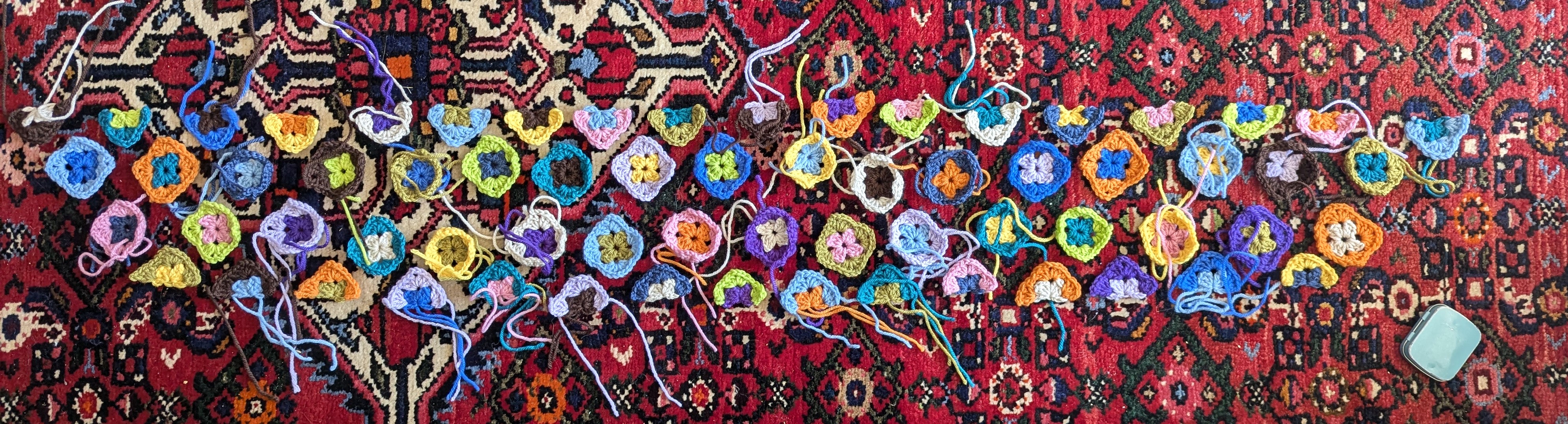
Arranging granny squares

When it comes to arranging the colour order of granny squares, I very rarely do anything other than follow my gut. I also make sure I have a fresh cup of tea, the TV remote and plenty of room to plan which squares sit next to which. The best course of action for a stash busting scarf like this is to not think about it too much!

Despite the photo above showing granny squares lined up on the sofa, I actually normally do this on the floor.

Easy Mini Bobble Crochet Edging

Once again, I want this project to be the ultimate in Mindful Crochet, so the mini bobble edging is quick and easy. You’ll find it timestamped in the video tutorial, so if you need a helping hand, you have it!

The Mini Bobble Stitch instructions:
This stitch is worked on the wrong side of the scarf/headscarf
Yo (yarn over), insert hook in st, yo and pull through, ch1 (3 loops on hook), yo, insert hook in same st, yo, pull through (5 loops on hook), yo, pull through all 5 loops on hook.

With the right side of the scarf facing you, join the yarn to any stitch.
Round 1: Ch1, 2sc in bar of horizontal dc sts, 1sc in corner ch-sps of squares, 1sc in centre circles of triangles, 3sc in scarf end points, continue in pattern around, join with sl st to first st, turn. – I am not going to worry about stitch count for this, it just isn’t worth the bother, and if you’re a stitch or two out, does it matter?!

Round 2 (Wrong Side): *1 mini bobble, 2sl st; rep from * around, join with sl st. Fasten off and cut yarn.

Aster Granny Square scarf crochet pattern with an easy bobble edging

Blocking Your Aster Granny Square Scarf

Blocking your crochet turns your work from OK to exceptional! It smooths out stitches and irons out wrinkles and potential warping. I highly recommend it. For my scarves, I chose to steam block them.

The moisture and heat from the steamer are enough to set the stitches beautifully. Steaming also doesn’t take as long as wet blocking, so if you’re in a hurry, it is perfect. A few hours of resting and Hey Presto!

Granny Square Scarves Forever!

If you would like to have all the details (and more) in one place (without the ads!), the PDF pattern is available for purchase from my Ravelry store, or you can also buy a copy (as well as my other crochet patterns) from my Etsy shop)

If you are looking for more Granny crochet inspiration, check out my Free Crochet Patterns. Let me know what you’re going to make next!

Cheers! x

Someone “helps” sew in the ends

Crochet Faux I-Cord Edging – A Simple Double Slip Stitch

Cerberus is a crochet pattern with three triangle shawls using houndstooth stitch with a Crochet Faux I-Cord Edging

Crochet Faux I-Cord Edging

Have you been looking for a simple crochet faux I-Cord edging to finish off your crochet projects? Here’s one! I came up with it recently, as I really didn’t enjoy working with other fiddly techniques to create a knitlook I-cord.

Although it is very easy, and the written pattern is provided below, I have created a video tutorial for this simple crochet border, too, which you’ll also find below. Sometimes it helps to see things visually.

The Crochet I-Cord Pattern at a Glance

  • Jump to the I-Cord edging pattern
  • Skill Level: Easy
  • Yarn Weight: Any yarn weight works. I used sock weight held with lace mohair yarn to create sport weight/light DK yarn.
  • Hook Size: 3.75mm (US F) hook. Or a crochet hook to match your chosen yarn weight.
  • Terminology: US crochet terms (with the occasional sprinkle of UK terms in brackets).
  • Dimensions: Any! It depends on what you’re making.
  • Construction: Worked in the round, in a continuous spiral.
  • Format: Written instructions below and a video tutorial on YouTube
  • Duration: 1-3+ hours, depending on the size of your project.
  • Where to use the pattern: Shawls, blankets, hoods.

Double Slip Stitch Edging

A crochet faux I-cord edging is essentially a double slip stitch. This is a very simple stitch to work and involves working a slip stitch across two stitches. It’s easy peasy, I promise! By repeating just one stitch around and around in a few continuous spirals, the crochet fabric starts to curl in on itself.

After three or four rounds, the slip stitches, sitting on top of one another, begin to form knit look crochet. For this easy crochet faux I-cord edging, as more rounds are worked, the fabric curls into a tube. Voila!

Crochet Faux I-Cord Edging worked in the round on this granny stitch balaclava

When to Use a Crochet Faux I-Cord Edging

So far, I have used this double slip stitch edging in two projects, and it looks ace! The pictures in this post heavily represent my Cerberus shawl. That’s because it’s a new pattern and I made loads of these crochet shawls because I LOVE them!! The edging is modern and simple, it’s a win win!

You can find my new houndstooth stitch shawl, Cerberus, on Ravelry and it is also available to purchase in my Etsy store.

The crochet faux I-cord is also a feature on a spanking new granny stripe balaclava I designed recently. This is so new that the pattern is only half written up, but it is a crochet design I very much want out in the world asap! Watch this space!

Both the Cerberus shawl and the granny balaclava have sections where you crochet in the round. That is when the crochet I-cord edging comes into its own. This border is specifically designed for working in the round, so if you have something in mind that’d work, add it and see how it transforms your crochet!

I think I’d like to try it around the top of a bag next; that would create a really modern look. Perhaps I might add it to a cowl design, or the cuffs on a pair of mittens? What would you add this double slip stitch edging to?

A Note on Using Contrasting Colours

In the neon Cerberus scarf, I used a contrasting colour for the crochet faux I-Cord edging. In the picture just below, you can see some neon yellow dashes. These are the back of the first round of slip stitches used in the scarf edging. It doesn’t bother me in the slightest. However, it might bother you. Let me share a little bit of info about using contrasting colours in this pattern.

Crochet Double slip stitch edging with contrast colour border

In the neon shawl, I went around the outside using a matching colour from the main body of the pattern, a brown yarn. Usually, this is the neatest way of creating a border in crochet: matching the colour of the yarn. Yet, here, it means that the first row of slip stitches is visible.

So, you can change it to the method I used on the version of Cerberus I made with the vibrant pink edging (pictured below). Quite a simple change, really. I used the pink to crochet around the outside of the shawl, thus matching the border colour rather than the main body of the shawl. Hmm, it isn’t usually my fave method, but here, I think it works.

Is that me being super fussy? Or is it useful information? Sometimes details matter. I think it’s helpful to have an understanding of the difference.

The construction of a Crochet Faux I-Cord Edging

Crochet Faux I-Cord Edging Pattern

The crochet faux I-cord edging is worked directly into a foundation round of simple single crochet stitches (that’s UK dc stitches). This foundation is crocheted around the main body of your project. Then the double slip stitch rounds are worked in a continuous spiral. It is the continuous spiral that creates the i-cord look.

How to Crochet the Double Slip Stitch (D sl st)

Instructions: *Insert hook in first st, yo & pull through (2 loops on hook), insert hook into next st, yo, pull through all loops; rep from * starting in st just used. 

Let’s take a look at it used in a pattern.

Note that I have not included how to crochet the foundation round of single crochet stitches, as this will be different from project to project. However, work a round of single crochet stitches onto your chosen crochet WIP. This will be your foundation round. Turn your work to begin so that the edging curls over to hide the “wrong side” of those sc stitches.

Edging Pattern

Place a stitch marker to show beg of the round. Move this up when you come around to it each time.
Rnd 1 (wrong side): Ch1, dsl st around, do not turn.

Rnds 1 – 4 (w/s): As Rnd 2, working in a continuous round. At the end of Rnd 4, work 1 sl st and fasten off. 

Optional ( you don’t need to do this, but it looks very neat & tidy): The edging will have naturally curled to the “wrong” side. Secure it in place by sewing a few stitches around. To work a stitch, insert the darning needle through the front loop of Rnd 4, and then through the corresponding backside of a stitch on the foundation round. This is demonstrated at the end of the crochet I-cord video tutorial.

A swatch to show a Crochet Faux I-Cord Edging

Interested in More Crochet Edging Inspo?

If you like this simple border, and you’re looking for more crochet edging inspiration, take a look at the patterns below. The Granny Triangle crochet shawl pattern and also, my Wayard Sisters shawl have a modern take on a scallop border. Or perhaps you fancy trying a simple crochet bobble border on this granny square blanket?!

You can find more Zeens and Roger free crochet patterns here!

Cheers! x

C2C Needle Case. Free Crochet Pattern

If you fancy a break from some of your bigger crochet WIPs, or you need to dip your toe back into crojo waters, then this little corner to corner needle case is the ideal quick crochet project. This easy c2c project has been sat in the archives for a couple of years. I designed it for a specific publication but it was never chosen (standard stuff in the design game!).

I won’t mess about I’m just going to pop the crochet pattern down below. If you make this speedy DIY corner to corner needlecase, please do let me know, I really love seeing projects made from the designs I share. Other crochet freebies are HERE or you can get some of my more in depth patterns on Ravelry & Etsy

If this is a crochet c2c pattern you’ve enjoyed, please do think about supporting me by gifting a few quid on Ko-fi

C2C Crochet Needlecase Pattern

Please note that this crochet pattern is written in UK terms (Essentially, where it says tr, that’s a US dc, a UK DC is a US sc).

Things you need to crochet your corner to corner case:
3 mm hook,
DK acrylic yarn, I used Stylecraft: 15g MC (Turquoise), 5g each CC 1 (Fuschia) & 2 (Lapis),
A button,
Felt: 11×16 cm approx, plus extra if making a pocket,
Needle for sewing button and felt.
Finished case measures approx: 7.5cm x 11cm

Row 1: With CC1 6ch, 1tr in 4th ch from hook, 1tr in next 2 sts, turn. [1 block]

Row 2: 6ch, 1tr in 4th ch from hook, 1tr in next 2 sts, sl st into the 3ch-sp of previous row, 3ch, 3tr into same 3ch-sp, turn. [2 blocks]

Row 3: 6ch, 1tr into 4th ch from hook, 1tr in next 2 sts, *sl st into next 3ch-sp of previous row, 3ch, 3tr in same 3ch-sp; rep from * to end, turn. [3 blocks etc]

Row 4 -8: Continue increasing as Row 3, change colour to MC at the end of row 4. 

Row 9: Repeat Row 3, ending with 1sl st  in the last 3ch-sp (ie. do not make the last block), turn. 

Row 10: Sl st along the next 3 sts and into the first 3ch-sp, [3ch, 3tr] in same ch-sp, continue making blocks in each 3ch-sp to the end, turn.

Row 11: Rep row 9  

Row 12: Rep row 10

Row 13 -19: Sl st along the next 3 sts and into the first 3ch-sp, [3ch, 3tr] in same ch-sp, continue making blocks, end with 1sl st into the last 3ch-sp, turn. Change to CC2 at the end of Row 15

To finish, sl st across the last 3 sts and into the corner, fasten off. 

With right side facing, go around the edge of the work with dcs: 2dc in horizontal st, 1dc in each vertical tr, 3dc in each corner.  At the centre of the right hand side, ch10 and join with a sl st and carry on with edging. Colour match as you go. Sew in ends. Sew on a button on the left hand side.

Hand stitch or glue felt to the inside. You could even add a little pocket!

Subscribe to Blog via Email

Enter your email address to subscribe to this blog and receive notifications of new posts by email.

crochet pattern for a c2c needle case

C2C CAL Kick Off!! – Havana Nights is LIVE!!

It is the start off the Corner to Corner Crochet Along!! Huzzah! 3…. 2…. 1…. GOOOOOOO!!

To celebrate these exciting times, get yourself over to Ravelry for 20% off all my Corner to Corner designs, including Havana Nights!! It is live!!

Havana Nights Blanket

ZZ Block (& Ziggy)

Geo Rainbow Blanket

Geo Rainbow Bag

C2C Geo (non Rainbow!) Bag

Off the Chart blanket

You don’t need a coupon code, the discount is automatically applied to these specific patterns. The discount ends on the 17th of November, which is the last day of the CAL.

Don’t forget that I’ve just released a freebie too. It is the Apres-Ski set and you can find it HERE.

If you missed the original C2C CAL post then go HERE, you’ll find loads and loads of inspiration, stuff about rules (there aren’t many), and let’s not forget PRIZES!!

You can play with charts on Stitchfiddle.com (not an affiliate thing, I just like it)

Apres-Ski. A free pattern and tutorial

So, get c2c-ing and I’ll be doing the same. I have ideas for two projects, possibly three… I wonder if I can squeeze them all in!? What are you going to make? Get chatting over on the Ravelry thread where you can share your ideas and what you’re up to! Remember, you can make anything you like as long as it’s corner to corner! Let’s have 6 weeks of C2C fun!

Subscribe to Blog via Email

Enter your email address to subscribe to this blog and receive notifications of new posts by email.

Geo C2C bags.

Free Pattern recipe for the Hotchpotch C2C bag.

Geo Rainbow bag

Off the Chart

Geo Rainbow Blanket

My favourite blanket, Havana Nights, claimed by my favourite girl.

xxx

Some More Crochet Easter Eggs

Decorative Crochet Easter Eggs

Am I too early for crochet Easter egg shenanigans? Eh, I don’t think so. Do you remember the pretty little crochet eggs from a couple of years ago? They’ve gone and got themselves some new mates!

A couple of weeks ago, I got an email from Hobbycraft asking if I was interested in trying some yarn so that I could tell you about it.  Seeing as spring is on the way, I thought it would be a nice idea to choose some yarn to make my amigurumi Easter eggs with. However, I didn’t want more eggs of the same size, so I’ve upped my game. I’ve gone large.

Yarn For Making Crochet Easter Eggs

This is the yarn I decided to try, The Women’s Institute acrylic dk. I wanted big Easter eggs this time, so I also chose the Soft & Chunky in Cream, which is an acrylic mix and has 30% merino. It’s lovely stuff to work with, I think merino is my favourite yarn in the world at the moment.

I also got some dk yarn in pretty spring colours to embroider the eggs with. A lighter yarn makes the embroidered decorations more delicate.

With two 100-gram balls of the chunky cream yarn, you can make three small eggs and one large. I weighed them before I added the embellishments, and a small one was 27 grams of yarn, whilst the large was 89 grams. I used exactly the same crochet pattern; I just doubled up on yarn for the biggy. By that, I mean I held the yarn double when working with it.

I’ve not used this yarn before, but I have used plenty of other DK acrylics. Mostly, I’m left unimpressed, and I have a thing where I don’t like mixing brands because the quality varies so much. Usually, they don’t pass muster, but I don’t think I’d have any qualms about mixing this with the likes of Stylecraft Special or Paintbox acrylic DK yarns (both of which are excellent to work with). This is one of the good ones. I have quite a bit of the dk left, so I might make a crochet blanket along with some other brands to really get a good feel for it (but not anytime soon, as I have got a massive list of other projects to do! Bah).

Anyway, on to the Easter Egg Crochet pattern…

Eeehh, look at the family all together!

Crochet Easter Egg Pattern

This pattern can be used with any weight of yarn, just make sure you use a hook size that will achieve nice, tight stitches (ie go down a couple of sizes than is recommended on the yarn label).

Notes & Things Needed To Crochet Easter Eggs

  • Women’s Institute Premium Acrylic Yarn DK in Yellow, Lime, Teal, Pink and Light Pink.
  • Women’s Institute Soft & Chunky in Cream x2 100g balls. This amount makes 1 large and three small eggs.
  • Polyfibre fill stuffing
  • Large eye darning needle
  • Fading ink pen (optional) – it helps to draw out where to put the flowers and leaves before you make the stitches.
  • For the small egg (approx 11cm tall) use a 4.5mm hook.  For the large egg (approx 17cm tall), use a 7mm hook and two strands of the chunky held together.
  • Use two strands of the dk together for embroidering the large egg.
  • US terms are used in the pattern.
  • An Inc = increase. i.e., working 2 stitches in the same stitch.
  • A dec = decrease. Worked over 2 sts.

This pattern below is also found on my original blog post HERE. And last year, I recorded a video tutorial showing how to make and embroider the eggs.

Amigurumi Easter Egg

Round 1: 6sc into a Magic Ring.
Round 2: Inc in each stitch around. [12 sts].
Round 3: *1sc in next stitch, inc in next; repeat from * around [18].
Round 4: Sc around. [18]
Round 5: *1sc in next 2 sts, inc in next; repeat from * around. [24].
Rounds 6-7: Sc around [24]
Round 8: *1sc in next 3 st, inc in next; repeat from * around [30].
Rounds 9-15: Sc around. [30]
Round 16: *1sc in next 3 sts, dec; repeat from * around. [24].
Round 17: *1sc in next 2 sts, dec; repeat from * around. [18].
Round 18: *1sc in next st, dec; repeat from * around [12].

Fasten off, leaving a long tail, 40cm should be plenty. 
Add embroidered flowers using simple stitches. French knots make the flower centres, and the chain stitch makes petals, leaves and stems.
Stuff firmly.
To close your Crochet Easter Egg, thread through the front loops and pull tight to gather the stitches together.
Stitch in and out a few times to fully secure and then snip the end neatly.

Here is a picture of the original Crochet Easter Eggs with embroidery made with DK yarn.

crochet easter eggs, an easy pattern for egg decorations

Please do let me know if you make some, I really would love to see. They make such cute spring decorations, and you could even tie pretty ribbon through the top to hang them in places!

And if you enjoyed making them, take a look at some of my other free crochet patterns.

Subscribe to Blog via Email

Enter your email address to subscribe to this blog and receive notifications of new posts by email.

Happy Easter! X

Another Granny Chevron Cowl! Pattern & Tutorial.

granny chevron cowl pattern

Crochet Granny Chevron Cowl Pattern

Fancy a very quick and easy crochet project? Last summer, I designed and made a fluffy granny stitch chevron cowl (see pic below). Yesterday I made a smaller, non-fluffy version. I made it when I was thinking about all things granny (I couldn’t wait for the Granny CAL! I just couldn’t!).

This morning I filmed a short tutorial too. It’s now up on YouTube if you want to go and have a look!

A drapey granny stitch chevron cowl pattern using fluffy yarn

A Fluffy Crochet Cowl Pattern

You can find the original crochet chevron cowl pattern, Here. It’s a much larger, drapier version using fluffy yarn. I made the new chevron cowl a bit smaller as I was restricted by the amount of yarn I had: 200 grams of chunky alpaca/mulberry silk stuff I found for £8 a skein from last year’s Edinburgh Yarn Festival.

The (impulsively bought) yarn had been sitting waiting for nearly a year, and I had no real idea about what to do with it for ages. It’s funny how something can jump out at you after all that time.

Some Granny Chevron Cowl Pattern Details

  • I used a 6mm hook for my chunky yarn.
  • The yarn I used was only 92 metres per 100g. I think other chunky yarns are usually a bit more than that. I used almost every bit, so if you don’t have at least 184 meters of chunky, then you might not make it to the end.
  • The granny chevron cowl measures approx 32×32 cm (12.5×12.5 inches). That’s a circumference of 64cm.
  • I chained 47 to begin, which gives you a total of 14 clusters per row
  • To make it bigger or smaller, add or subtract 6 chains when you begin. That’s enough for a granny cluster for each side of the chevron pattern.
  • The pattern is written in UK terms. The video uses both UK and US terms, but essentially all you need to know is that a UK treble is a US double.
  • 3tr = cluster.
  • Feel free to keep on going to make a bigger version. Why not turn this snug-fitting cowl into a cosy infinity scarf?!

Granny Chevron Crochet Cowl Pattern

Chain 47.
Row 1: 3tr in 7th from hook, (miss 2 sts, 3tr in next) six times, ch2, 3tr in next st, (miss 2 st, 3tr) six times, miss 2 st, 1tr in last st, turn.
Row 2: Ch3, (3tr in space between clusters) six times, (3tr, ch2, 3tr) in 2 chain space, (3tr in space between clusters) six times, 1tr in last st of row, turn
Rows 3 – 29: Rep Row 2, changing colour every five rows.
Row 30: As Row 2, but slip stitch to join to Row 1 between each cluster. Fasten off and sew in ends.

I hope you like it. I promise it’s super easy to make and can be made in a couple of hours (maybe less, I didn’t time it).

Jeepers, I’m not wearing make-up on me peepers. Again!

Subscribe to Blog via Email

Enter your email address to subscribe to this blog and receive notifications of new posts by email.

x

Granny Stitch Crochet Baubles Pattern & Tutorial!

Christmas Granny Stitch Crochet Baubles

Christmas is pretty much just around the corner, honestly, it’ll be here before you know it. I’ve noticed this year that crochet baubles are all the rage, so I’ve had a go at my own simple bauble pattern. I’ve put together a tutorial for YouTube too, so if that’s more your thing, then do jump across to my YouTube channel… Here is where you’ll find the crochet bauble video!

It’s always surprising just how quickly these granny stitch crochet baubles work up, and you will find yourself making loads and loads! The more the merrier with a colourful crochet bauble. They look so good, decorating a Christmas tree, when there’s a gaggle of them (I’m not sure what the collective noun of a bauble should be, so if you have any suggestions, let me know!).

Anyway, rather than any further preamble, go get your decs out and get crocheting!

If you would like to support my crochet adventures, feel free to check out my other Crochet Free Patterns. Cheers! x

Things You Need to Crochet Granny Stitch Baubles

  • 6cm (diameter) baubles. Mine are from Sainsbury’s, but I bought similar from Wilko’s last year. I think they’re a fairly standard bauble size.
  • 3mm crochet hook.
  • DK cotton in different colours. I’ve tried many brands, and they’re all good: Paintbox Cotton, Drops Muskat,  DMC Natura, Stylecraft Classique, etc…

Crochet Bauble Pattern Notes

  • Fasten off (FO) after each round and join the new colour with a ss (slip stitch) just to the right of where you fastened off.
  • If you want to avoid sewing in most ends, crochet over them as you go, but it is worth sewing them in if you have the time and patience.
  • UK terms are used in the written pattern, and I use both UK & US in the video. Things to remember are: a UK tr is a US dc. A UK dc is a US sc.
  • Make 2 of the pattern for each crochet bauble.
  • Please read the whole pattern through before starting.

Granny Stitch Crochet Bauble Pattern

Begin with a Magic Circle (or ch4 and join with a slip stitch).

  1. Ch1, 1tr, ch1, *tr2tog, ch1; rep from * 5 times, join with a ss to the top of the first petal. [6 “petals”]
  2. (Ch2, 1tr, ch1, tr2tog, ch1) in same space, (tr2tog, ch1, tr2tog, ch1) in each 1ch sp, join with a ss to the top of the first petal. [12 “petals”]
  3. Ch3, 2tr in first ch sp, 3tr in each ch sp around, join to top of the ch3. [12 clusters]
  4. Ch2, 1htr in each st around. [36 st]
  5. Ch1, 1dc in each st around, join with ss.

Make the two halves.
Sew in any ends.
Do not FO after Round 5 on the second half.

Place both halves together, right sides out, and slip stitch together, facing loops only. At just over the halfway point, wriggle the bauble into its granny crochet jacket and continue to slip stitch together. This can be fiddly, but it’s worth it! Sew in the last end, using it to tidy around the hanging bit of the bauble if you need to.

How Many Granny Stitch Crochet Baubles Will You Make?!

And the next instruction is to crochet several granny baubles!! As I said earlier, with crochet baubles, in my opinion, it’s a case of the more the merrier. Think of all the differetn colour combinations you can put together. So gather all your yarn scraps, and get crocheting! Christmas is always a time to be merry (and bright!). Let’s decorate it in crochet!.

Please do give me a shout if you have found the crochet bauble pattern/tutorial useful. A thumbs up on YouTube helps too. Thank you very much!

Also, please feel free to go ahead and share a link to this free crochet pattern. Sharing is truly marvellous! But I ask (really rather nicely, please, thank you, please) that you credit Zeens and Roger if you do. Thanks again.

Subscribe to Blog via Email

Enter your email address to subscribe to this blog and receive notifications of new posts by email.

Get working on your crochet baubles! Cheers. x

Connie’s Blanket. A Colourful Crochet Granny.

granny square blanket for the home

Pretty Granny Square Blanket

It feels like this pretty crochet granny blanket has been in the making for aaaaggess. Relatively speaking, that’s probably not true. I started making granny squares because I had leftovers from the Crazy Chevron blanket I made back in February.

Trying (unsuccessfully) to reduce the yarn stash has been the aim for quite a while. For this chap, a few colours were swapped depending on what there was most of in my “collection”. I only bought two extra balls to complete the blanket.

If you watch my crochet podcast on YouTube, you’ll have heard me go on about this in nearly every single episode so far! I thought you guys might be interested in a blog post, too, and it’s a good idea to have all the info in one place. So here we are!

Connie's Crochet Blanket. A JAYG granny square blanket using all the dk stash

Connie’s Crochet Blanket

This colourful crochet creation is now called Connie’s Blanket. I didn’t know when I started that it would end up as a birthday present, but at some stage or other it decided (not me), that that was what it was!

colourful crochet granny square blanket made for Connie.

Crochet Blanket Stats

Connie’s Blanket is made up of 130 squares (10×13), which were attached using the Join As You Go technique. The pattern and construction are similar to a blanket I made a few years ago. That one is nattily entitled Crochet Circles in a Square blanket. That blog post has links for all you need if you’re going to make a granny square blanket like this. I’ll break it down here too…

Crochet Circle pattern.  The difference in Connie’s blanket is that I used a magic ring to start each circle, and there were no chains between the treble crochet stitches (US dc’s) of the first round. Oh, and no double trebles on the joining round, just some trebs.

Here is one of my Join As You Go tutorials. It’s for another granny project, but the principle is the same.

Yarn Stash Used

I used Stylecraft Special DK in the following colours: Duck Egg, Spring, Fondant, Fuschia, Shrimp, Lobelia, Apricot, Grey, Kelly, Cloud, Mustard, Wisteria,

I made all the inner circles first (well, most of them – I kept adding more when I saw I had enough yarn for more rows), then evenly distributed those between the shades. I haven’t checked, but I reckon they’re all unique.

Easy crochet Scallop edging with a twist

The border is dead simple. Three rounds of Grannies, 1 row of UK treble stitches (US dc) and a simple scallop edging.

To jazz up the edge a bit more, I ended up doing this: Starting in a dip (between scallops): *(ch2, 1dc after next treble – so between the tr sts) x4, ch2, 1sl st in the dip; rep from *.

And here is a YouTube crochet podcast where I chat about the blanket (and episodes before this one tbh!)

A granny square Join As You Go crochet blanket. Connie's blanket

And that’s pretty much it. Granny Square blankets like these are one of my favourite things to crochet. I don’t know why, they just are! What about you? How do you get on with granny blankets?! I know some people think they’re naff and old fashioned, but I can’t help but love em!

Subscribe to Blog via Email

Enter your email address to subscribe to this blog and receive notifications of new posts by email.

Save

Save

Save

Corner to Corner Broken Heart

broken-heart-corner-to-corner-crochet

What Becomes of the Crochet Broken Hearted?!

Coming up to February, hearts are everywhere. I get it, love is in the air and all that, but what if you don’t want to get all schmaltzy and saccharine about it?!

This is my answer: crochet a broken heart! I’ve come up with a crochet corner-to-corner graphgan design that’s cute but not pukey. How great is that?! To make your own crochet heart, read on…

crochet-heart-cushion

I chose neon pink (almost impossible to photograph by the way) and a light grey aran yarn. I was all set to go for a blue background colour until I found out I didn’t have enough yarn. This pattern needs two balls of the grey and one of neon pink, with just a scrap of blue for the shiny reflection.

a-broken-heart-stitch-fiddle-pattern

I recently learned about a chart making website called Stitch Fiddle. It’s brilliant! You can make up your own crochet designs for knitting, cross-stitch and crochet. It’s free to do the basic stuff, but I’m tempted to sign up for the fancier version. You get fifteen freebies; after that, you have to pay.

I haven’t used it to do crochet diagrams yet, but I’m probably headed that way.  Anyway, I’m not here to sell their stuff. I shall move on…

Above is the graphgan chart to use. I think it can be printed off if you save it as a document, then you can mark off the squares as you go. I started in the bottom right corner.

broken-heart-crochet-c2c

Things Needed to C2C a Broken Heart

  • 2x 100g balls of background colour, 1x ball for heart, a few metres of a third colour. It’s aran weight yarn
  • 4.5mm hook. (If you have a particularly loose tension, try a 4mm).
  • 1x 50cm cushion pad
  • 1x 50cm cushion cover
  • Sewing needle (not as giant as a darning needle, but big enough to squeeze the yarn through, it needs to go through the cushion cover).

Before you begin, the first thing you need to do is separate out about 20 grams of the grey yarn, this will be the ball you use to work between the two heart pieces. The thing about making crochet graphgans is that you need a ball/bobbin for each section of colour. I had three grey and two pink balls being worked at the same time (I wound a separate ball of the pink yarn too, just under half). It’s not as tricky as it sounds, I promise. It’s very hard to explain, but very easy to do! As long as you know how to Corner to Corner, this is really simple to achieve.

I learned how to do a C2C from a pattern I got from Ravelry, but I’ve found this video by Bella Coco, which I wish I’d seen at the time!

Here is a video about colour changes. It was immensely helpful and got to the point. No faffing, thank goodness.

back

I kept all my workings on one side (it’s a cushion, they’re not going to show on the wrong side). To avoid lots of these, make sure you keep one ball of pink for one heart half, and the other for the other. There are a couple of places where the yarn would be carried over too many blocks if you didn’t split the yarn, and that might look messy. If you look too closely at the picture above, you can see where I broke that rule. Just don’t look.

pinning

Pin your finished piece to the front of a cushion cover. Pin the four corners first, then add a couple more pins inbetween. I found my cushion cover from Amazon, it was about £3, which is better than the £4.50 it would have cost to buy two more balls of yarn to do a plain c2c back, and more time efficient. Woohoo for saving time and money!

sewing-on-to-the-cushion
stitchy-stitch

Stitch it on. The ends can be woven in when it’s finished.

sewn-up
crochet-cushion

Keep the stitches as close to the edge as possible.

cosy-cushions

Finished! A giant crochet cushion with a broken heart!

Let me know what you think. Do tell me if you make one, I would absolutely love to see it. Please feel free to make as many as you like, and why not check out some of my other free crochet patterns!? Thanks.

Subscribe to Blog via Email

Enter your email address to subscribe to this blog and receive notifications of new posts by email.

Thistlebear

Save